MARINO PH
Your Maritime Digital Hub

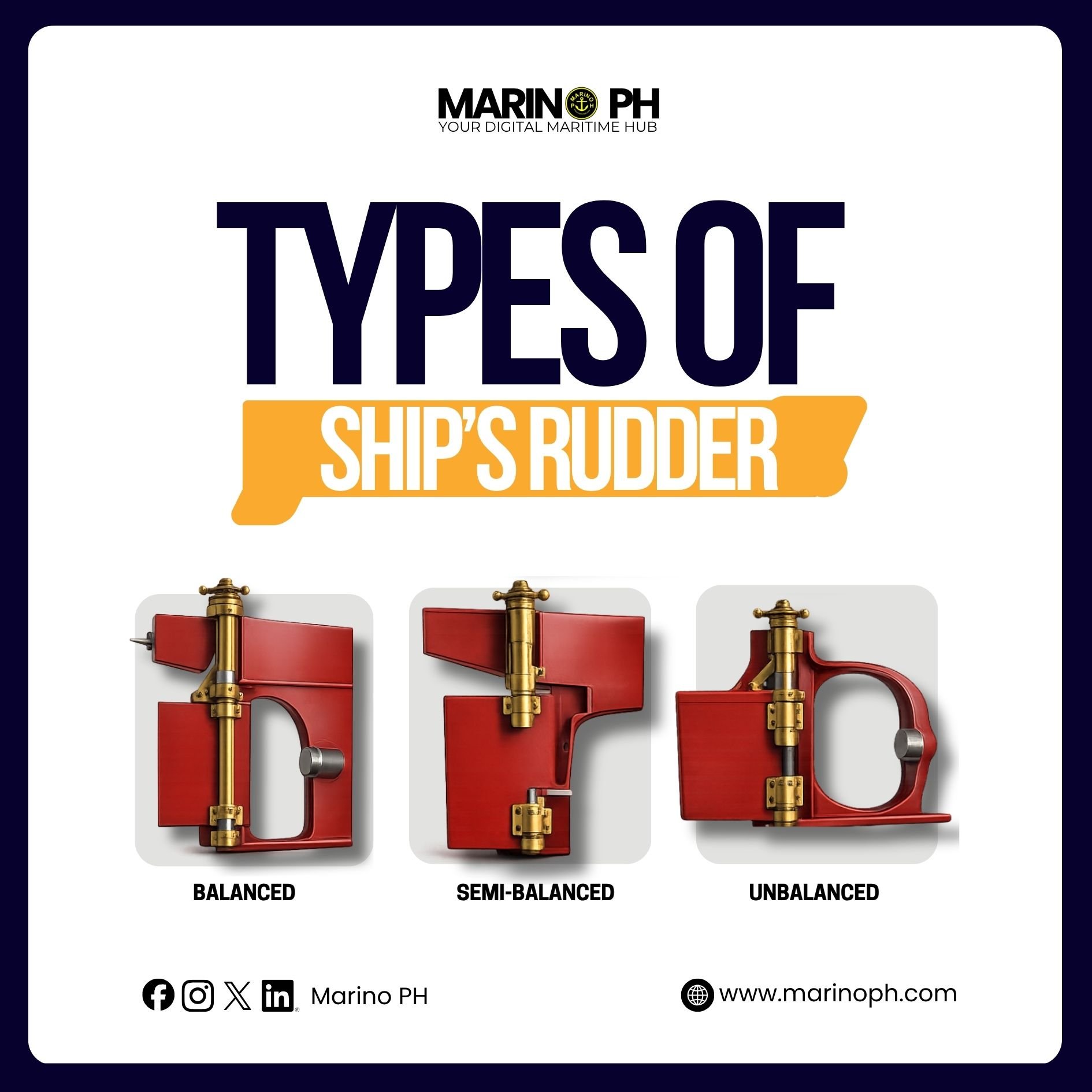
A ship\\'s rudder is an essential hydrodynamic control surface used to steer a vessel through the water. Mounted at the stern, typically just behind the propeller, it functions by deflecting the water flow as the ship moves forward. This deflection creates a transverse force that pushes the stern to one side, seamlessly altering the vessel\\'s overall heading. The efficiency, maneuverability, and mechanical power required to steer a ship depend heavily on the specific engineering of this mechanism. The graphic provided in rudder.jpg highlights the fundamental design variations, which are categorized based on how the rudder\\'s surface area is distributed relative to its pivoting axis (the rudder stock).

Balanced Rudder: The turning axis is positioned so that a specific portion of the blade area sits forward of the axis. This forward section catches the water flow and assists in pushing the rudder into the turn, effectively balancing the hydrodynamic load and drastically reducing the mechanical effort required to steer.
Semi-Balanced Rudder: This design acts as a hybrid. Its upper section is unbalanced and typically hinged to a fixed structure (the rudder horn) to provide vital structural support. Meanwhile, the lower, free-hanging portion extends forward of the turning axis to provide a partial balancing effect, offering an optimal mix of structural strength and steering efficiency.
Unbalanced Rudder: The entire surface area of the blade is positioned aft (behind) the turning axis. Because there is no blade area forward of the axis to help initiate the turn, the steering gear must bear the full force of the water pressure, requiring heavier machinery and significant mechanical torque.
