
MARINO PH
Your Maritime Digital Hub

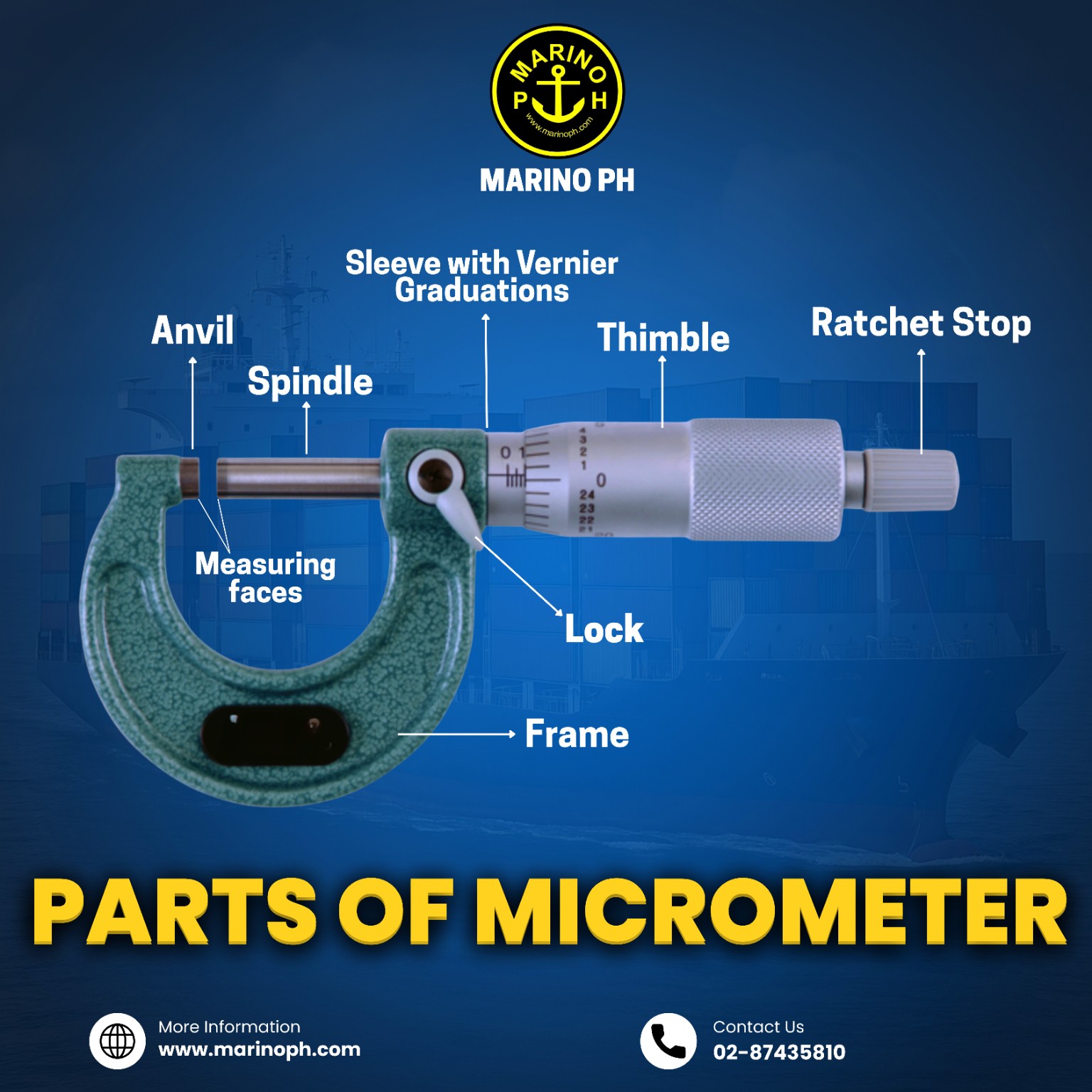
What is a Micrometer
A micrometer is a precision measuring instrument widely used in engineering, machining, ship maintenance, and industrial applications where accuracy is critical. It is designed to measure very small dimensions such as thickness, diameter, and length with high precision.
Understanding the different parts of a micrometer helps users operate the tool correctly and achieve accurate measurements.

ADVERTISMENT
Key components and their functions:
1. Frame
The frame is the sturdy C-shaped body of the micrometer. It provides structural support and maintains the alignment between the anvil and spindle. A rigid frame ensures consistent and reliable measurements.
2. Anvil
The anvil is the fixed measuring surface attached to the frame. It serves as one contact point for the object being measured.
3. Spindle
The spindle is the movable measuring surface that advances toward or away from the anvil when the thimble is rotated. The distance between the spindle and anvil represents the measured dimension.
4. Measuring Faces
These are the flat, hardened surfaces of the anvil and spindle that come into contact with the workpiece. Clean and well-aligned measuring faces are essential for accurate readings.
5. Sleeve with Vernier Graduations
The sleeve contains the main scale and vernier graduations, allowing users to read measurements with high precision, often down to hundredths or thousandths of a millimeter.
6. Thimble
The thimble is the rotating component used to move the spindle. It has calibrated markings that work together with the sleeve scale to provide precise measurement values.
7. Ratchet Stop
The ratchet stop ensures consistent measuring pressure by slipping when the correct force is applied. This prevents over-tightening and helps maintain measurement accuracy.
8. Lock
The lock holds the spindle in place after measurement, allowing users to record or transfer readings without losing accuracy.
Why Proper Knowledge Matters
Knowing the parts and functions of a micrometer improves measurement accuracy, extends tool lifespan, and promotes safe and effective use especially in professional and maritime environments.
