
MARINO PH
Your Maritime Digital Hub

What is a chain block
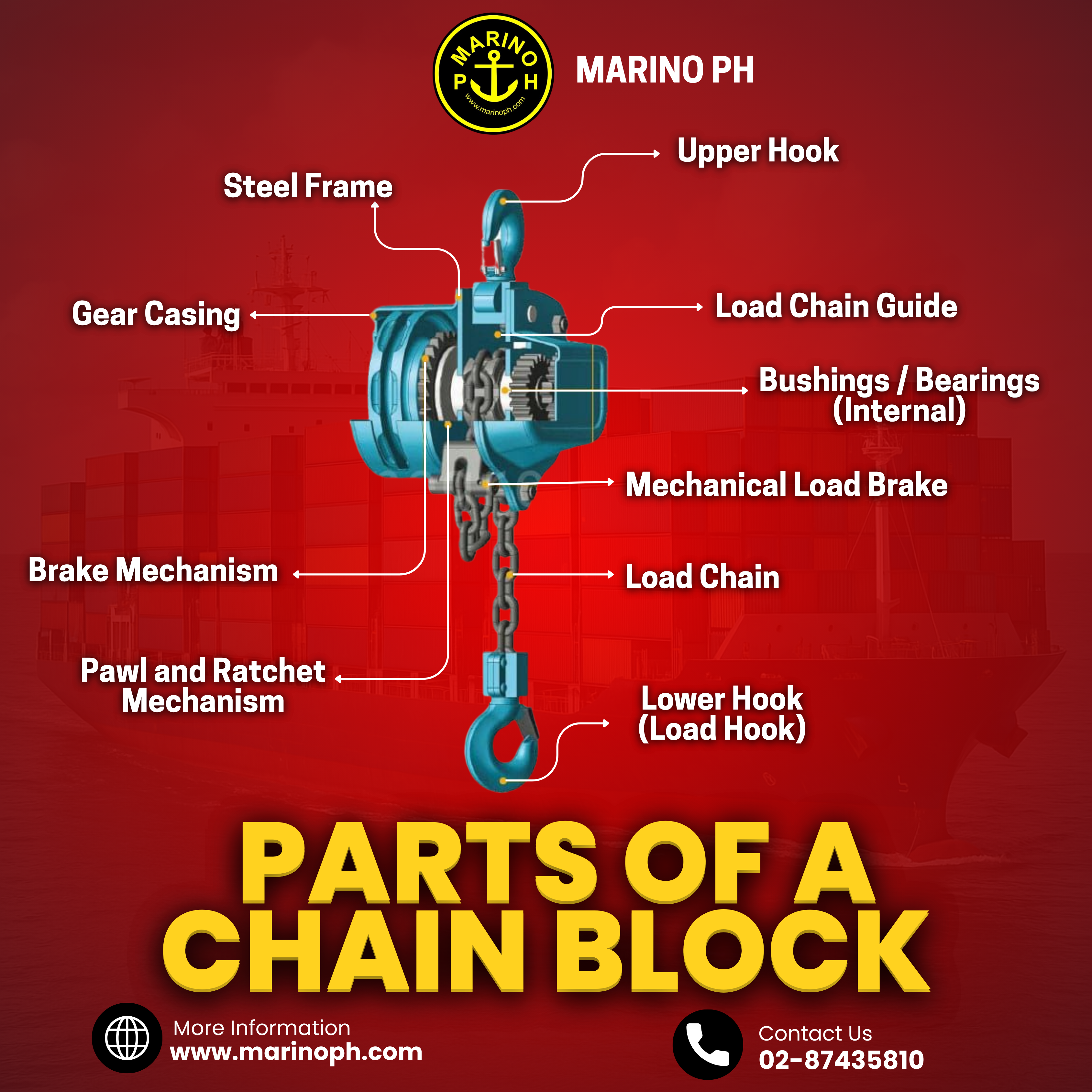
A chain block, also known as a manual chain hoist, is a mechanical lifting device widely used in maritime, shipyard, construction, and industrial environments. The image illustrates the key internal and external components of a chain block, including the steel frame, gear casing, load chain, braking system, hooks, and internal bearings. These parts work together to lift, lower, and hold heavy loads safely using manual force.
The robust steel frame houses the internal gears and brake mechanism, while the upper hook allows secure attachment to a beam or lifting point. The load chain passes through the chain guide, ensuring smooth movement and proper alignment during operation. Inside the gear casing, bushings, bearings, and gears reduce friction and multiply force, enabling efficient lifting.
Purpose
The primary purpose of a chain block is to lift, suspend, and precisely position heavy loads in areas where electrical or hydraulic lifting equipment may be unavailable or impractical. In maritime operations, chain blocks are commonly used for engine maintenance, cargo handling, machinery installation, and ship repair work.
The integrated mechanical load brake and pawl-and-ratchet mechanism are critical safety features. They automatically hold the load in place when lifting force is released, preventing accidental lowering and ensuring controlled, step-by-step operation. This makes chain blocks especially suitable for confined spaces and onboard ship environments.

Key Components and Their Functions
•Upper Hook – Connects the chain block to a fixed support structure.
•Steel Frame – Protects internal components and supports the load.
•Gear Casing – Encloses the gear system that multiplies lifting force.
•Bushings / Bearings (Internal) – Reduce friction and ensure smooth gear rotation.
•Load Chain Guide – Keeps the chain properly aligned during lifting and lowering.
•Mechanical Load Brake – Holds the load securely when force is released.
•Brake Mechanism – Controls descent speed and prevents free fall.
•Pawl and Ratchet Mechanism – Allows one-directional movement and load locking.
•Load Chain – Transfers lifting force to the load.
•Lower Hook (Load Hook) – Attaches directly to the cargo or equipment being lifted.
Importance in Maritime and Industrial Use
Chain blocks are valued for their simplicity, reliability, and safety. They do not rely on electricity, making them ideal for emergency use, hazardous areas, and onboard vessels. Their compact design allows them to be used in tight engine rooms and deck spaces, while their durable construction ensures long service life under heavy loads.
Summary of the Topic
A chain block is an essential lifting tool that combines mechanical efficiency with safety and durability. Understanding its parts—such as the braking system, gears, hooks, and load chain—is crucial for proper operation, inspection, and maintenance. In maritime and industrial settings, chain blocks play a vital role in safe lifting operations, equipment handling, and day-to-day maintenance tasks.
ADVERTISMENT
ADVERTISMENT
