
MARINO PH
Your Maritime Digital Hub

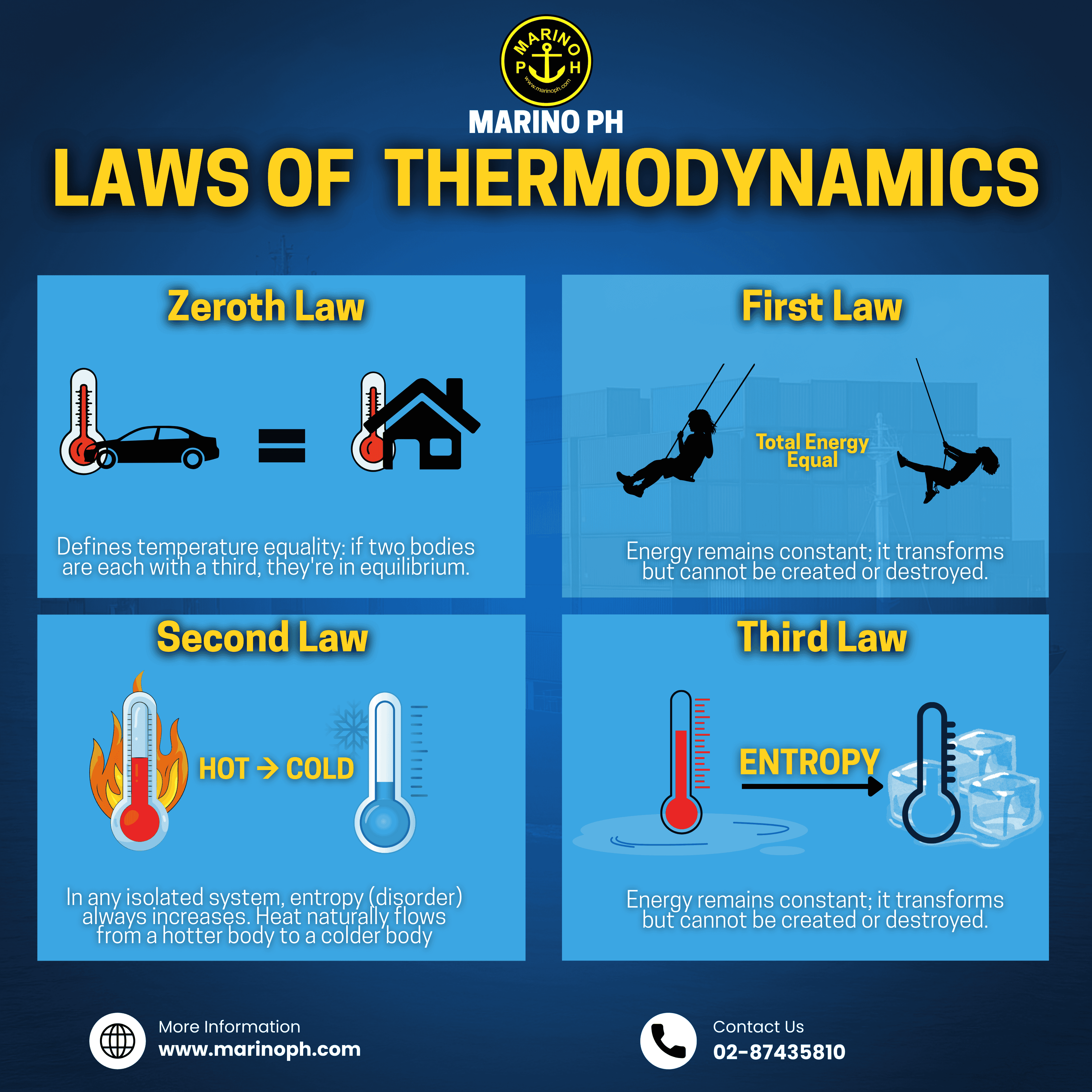
The Laws of Thermodynamics: Essential Principles Behind Heat, Work, and Energy
Understanding the Laws of Thermodynamics is fundamental in engineering, science, and industrial operations. These four principles describe how heat and energy behave in physical systems whether in marine machinery, automotive engines, refrigeration units, or power plants. Each law provides critical insights that help engineers design safer, more efficient, and more reliable systems.
Zeroth Law of Thermodynamics: Foundation of Temperature Measurement
The Zeroth Law states that if two bodies are each in thermal equilibrium with a third body, then all three are in equilibrium with one another. This simple but powerful principle forms the basis of all temperature measurement. It ensures that thermometers can serve as accurate reference points in determining temperature across different systems.
First Law of Thermodynamics: The Conservation of Energy
The First Law explains that energy cannot be created or destroyed it can only change forms. In marine and industrial applications, fuel energy is transformed into mechanical work, heat, and other forms of output. Although energy transitions from one type to another, the total amount within the system remains constant. This principle drives the design of engines, generators, and thermal processes.

ADVERTISMENT
Second Law of Thermodynamics: Entropy and Natural Heat Flow
The Second Law introduces the concept of entropy, describing the natural tendency of systems to move toward disorder. It also states that heat naturally flows from a hotter body to a colder one unless external work is applied. This law explains why no machine can operate at 100% efficiency and why energy losses in the form of heat are unavoidable in real-world operations.
Third Law of Thermodynamics: Entropy at Absolute Zero
The Third Law states that as a system approaches absolute zero temperature, its entropy approaches a minimum value. At this extreme limit, molecular motion becomes nearly perfect and ordered. Although absolute zero is theoretically unreachable, this law is vital in fields such as cryogenics, materials research, and quantum science.
Why These Laws Matter in Engineering
From ship engines and HVAC systems to industrial refrigeration and power generation, the Laws of Thermodynamics guide how we design, operate, and optimize equipment. They ensure that energy use is predictable, efficient, and safe making them essential knowledge for marine professionals, engineers, and technical operators.
